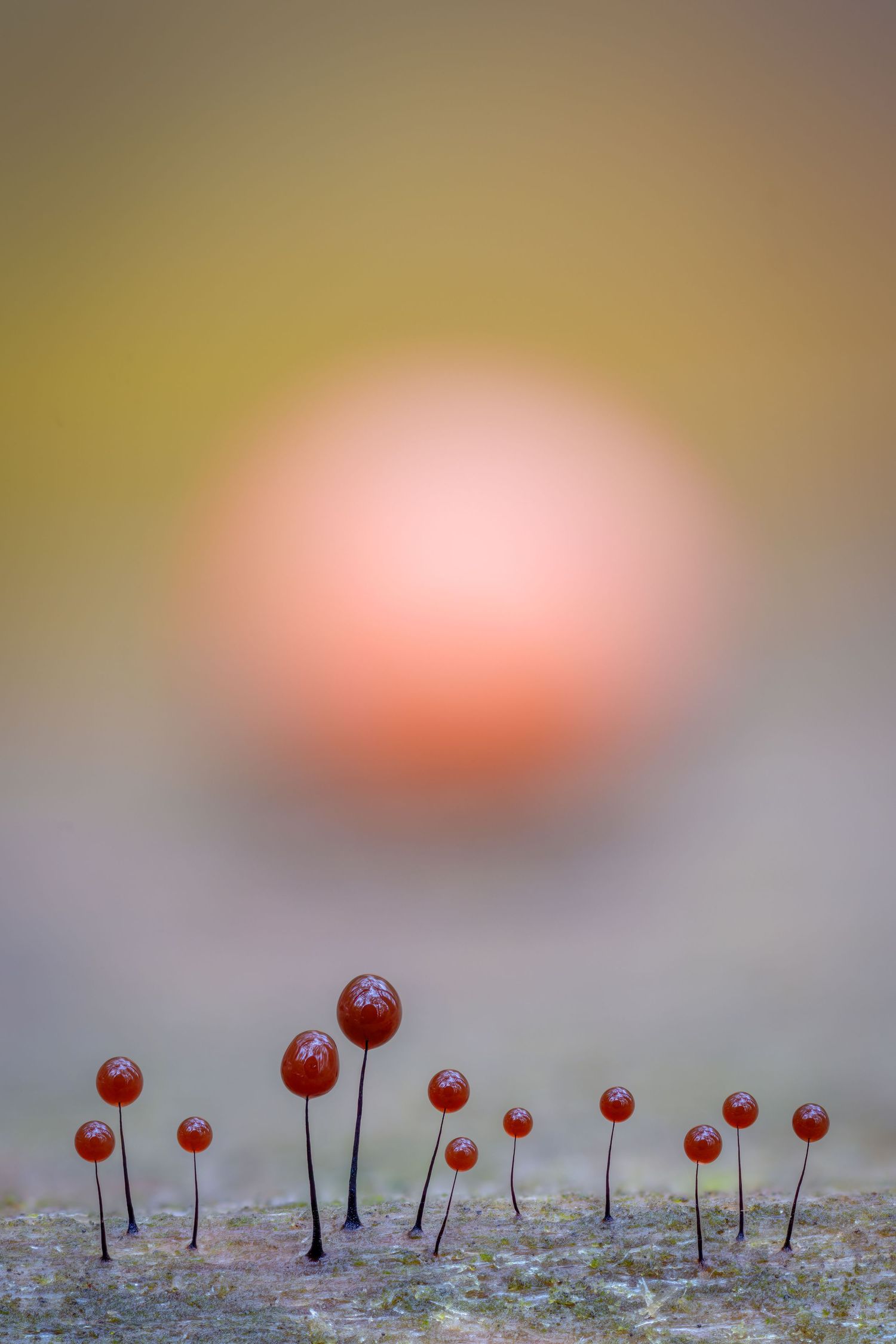
When I first picked up a camera in 2012, I never imagined that one day I would become so passionate about photographing slime molds. Like many photographers, I started by capturing landscapes, sunrises, sunsets, and wildlife. I spent countless hours outdoors, exploring nature and learning everything I could about photography. Over time, my interest gradually shifted towards macro photography, where I discovered an entirely new world. Macro photography became my favourite subjects.
I first photographed a slime mold in October 2024 during one of my fungi photography workshops. At the time, I knew very little about them and honestly thought that slime mold was the name of a single species. I took a few photographs simply because they looked interesting and unusual amongst the fungi I was photographing.
After the workshop, I shared my images in a fungi and mushroom photography group on Facebook. Several members suggested that I post them in a dedicated Slime Mold Identification Group, where experts could help identify the species. I'm very glad I took their advice.
Joining that group completely changed my understanding of slime molds. I quickly discovered that slime molds are not a single species at all, but an incredibly diverse group of organisms with thousands of species found around the world. Even more surprising was learning that over 300 species can be found in the UK alone.
As I began seeing photographs shared by other enthusiasts and researchers, I realised that an entirely different and stunning microscopic world had been hidden beneath my feet all along. The variety of shapes, colours, textures, and structures was simply incredible. Some looked like tiny jewels, others resembled alien landscapes, while many appeared more like works of art than living organisms. From that moment, I fell in love with slime molds.
What began as curiosity quickly became a passion, and I made a personal goal to photograph as many species as possible. Throughout 2025, I dedicated countless hours to searching woodlands, fallen logs, leaf litter, and decaying branches in pursuit of these fascinating organisms. Every woodland walk became a treasure hunt. Some days I would find nothing, while other days would reveal species I had never seen before.
As my obsession grew, so did my photographic techniques. Slime molds are often only a few millimetres tall, requiring specialist macro photography and focus-stacking techniques to reveal their incredible details. Learning how to photograph them effectively became just as rewarding as finding them in the first place. What fascinates me most is that every slime mold has its own character, colour, and structure. Even the same species can appear completely different depending on its stage of development. This constant variety is one of the reasons I continue to be inspired by them.
In this blog, I'll share the stories behind some of my favourite slime mold photographs, along with selected wildlife, macro, and landscape images from my photography journey. I'll talk about how the images were captured, the challenges involved, and the experiences that made them special. I hope these stories encourage you to slow down, look closer, and discover the incredible hidden world that exists all around us often in places we walk past every day without ever noticing. 📷🍄✨
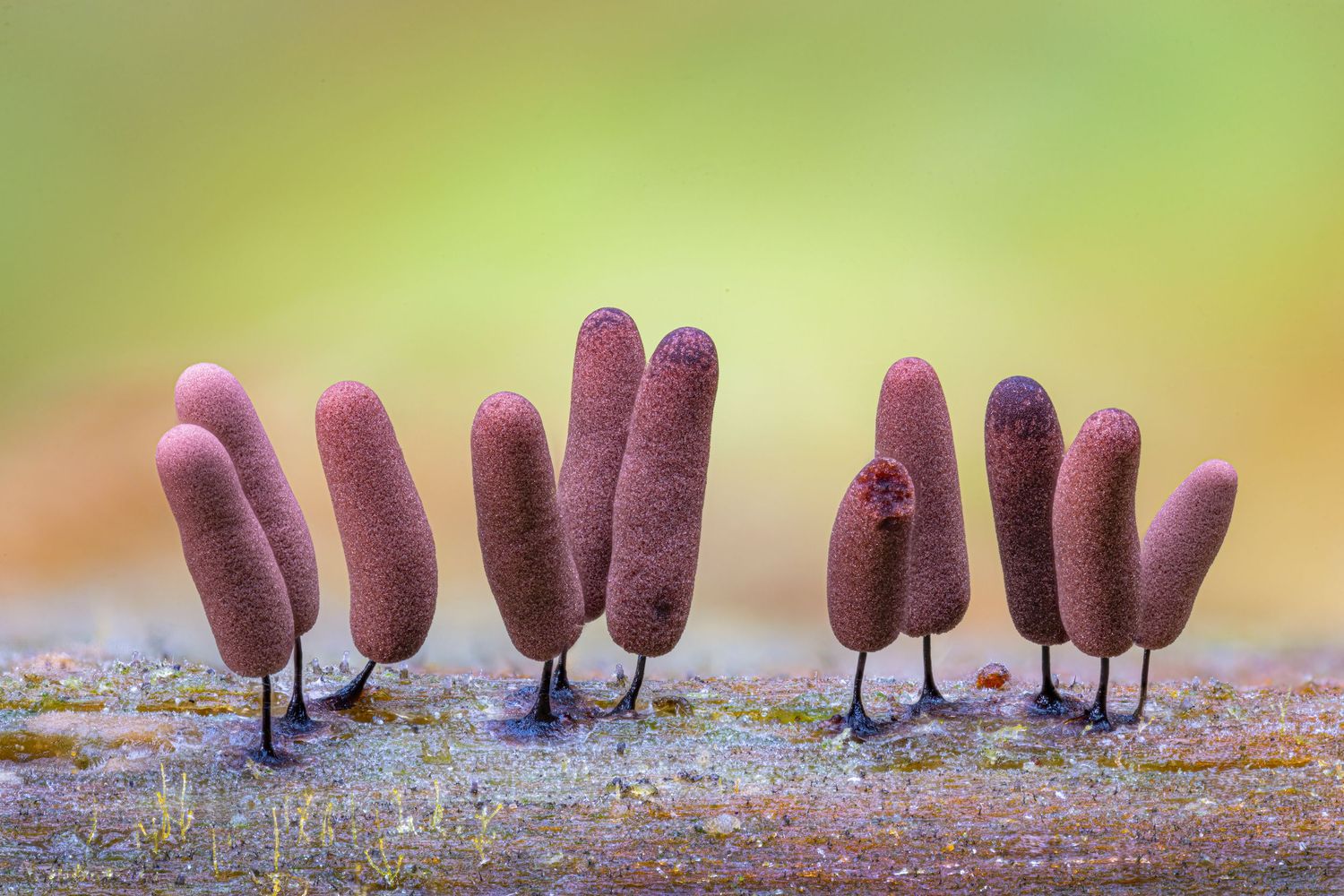
( Trichia decipiens ) My first slime molds picture taken during my fungi photography workshop
Being in the Right Place at the Right Time
When it comes to photographing slime molds, being in the right place at the right time is often just as important as having the right camera equipment. The fruiting bodies of many slime molds have incredibly short life cycles. Some species can mature and release their spores within just one or two days, meaning the opportunity to photograph them at their peak can be gone almost as quickly as it appears.
Many people don't believe in destiny, but I do. I believe that success in photography comes from a combination of luck, hard work, and talent. Luck might lead you to discover a rare species at the perfect moment. Hard work keeps you searching woodlands in all weather conditions, often for hours without finding anything. Talent helps you see the creative potential in a subject and turn it into a compelling photograph. When all three come together, something truly special can happen.
Over the years, I've had several moments where everything seemed to align perfectly. A rare species appearing at exactly the right stage of development, perfect weather conditions creating beautiful dew or frost, or simply being in the right woodland at the right time. These moments cannot be planned, but they can be earned through persistence and dedication.
In the following stories, I'll share some of my favourite slime mold photographs and the experiences behind them. Many of these images were only possible because of a fortunate combination of timing, patience, preparation, and a little bit of luck. They remind me that nature often rewards those willing to keep exploring and never stop looking closely.
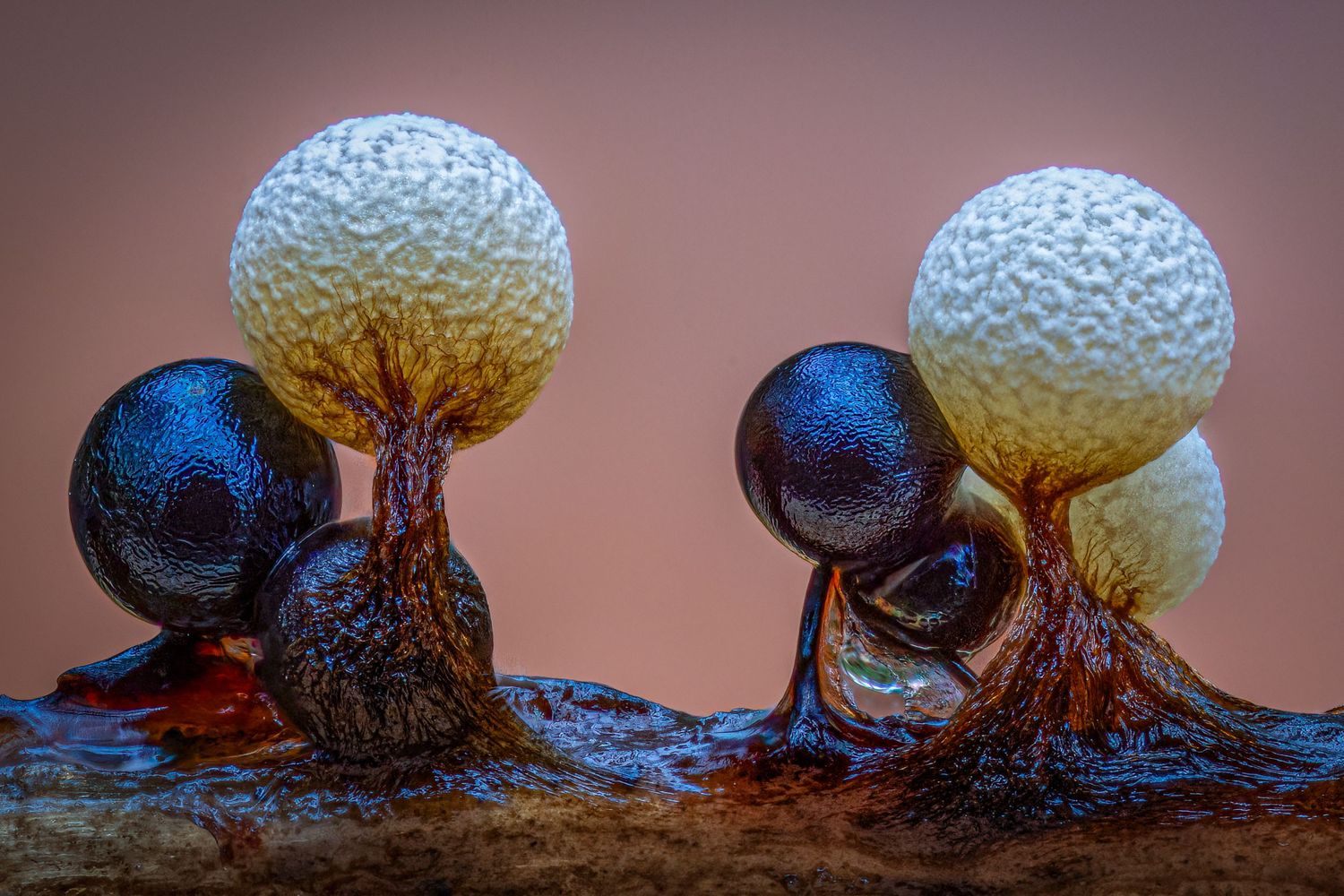
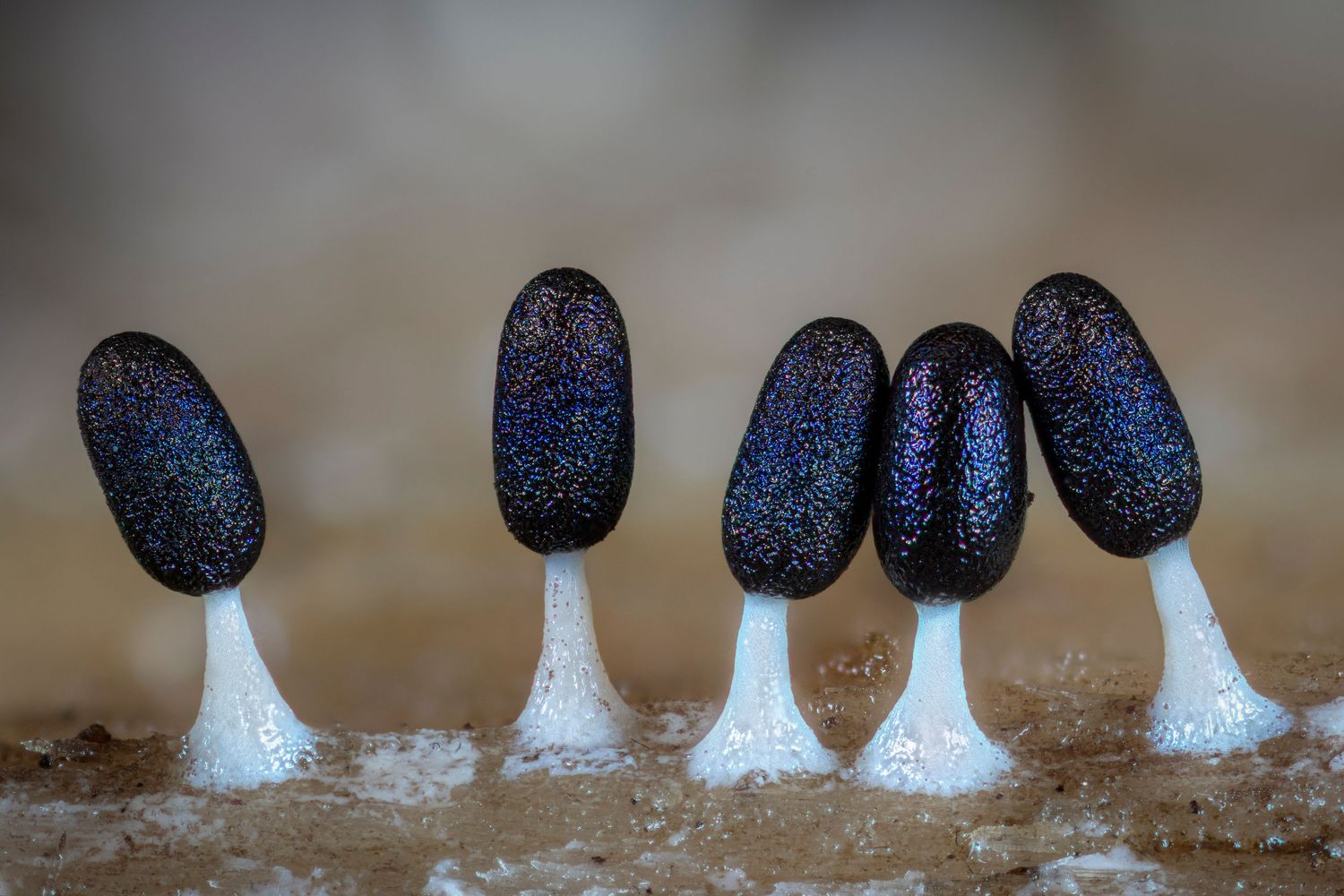
Lamproderma violaceum ( Black ) Physarum pusillum ( White )
📷 Camera: Canon EOS R5
🔍 Lens: Canon MP-E 65mm f/2.8 1–5x Macro Lens
⚙️ Settings: f/4.5 | ISO 160 | 0.3 sec
📸 Focus Stack: 92 images
☀️ Lighting: Natural light
When Bad Things Lead to Good Discoveries
Sometimes bad things happen for a good reason.
As photographers, we often spend hours planning trips, researching locations, checking weather forecasts, and hoping everything comes together on the day. But every now and then, nature has other plans — and sometimes those unexpected changes lead to even better opportunities.
In late summer, I had planned a visit to Slindon Wood in search of slime molds. I was looking forward to a full day exploring the woodland, hoping to find some interesting species to photograph. However, that morning started very differently than expected.
As I prepared to leave, the engine warning light appeared on my car dashboard.
Instead of heading to the woods, I found myself driving to a local garage. After dropping the car off, I returned home feeling disappointed. My carefully planned day had suddenly fallen apart. With no transport and no alternative plans, I found myself sitting on the sofa wondering what to do next.
While thinking about my options, a location popped into my mind.
A few weeks earlier, I had noticed council workers clearing trees in a nearby open area. They had been feeding branches through a woodchipper, leaving several large piles of fresh woodchips behind. From previous experience, I knew that woodchip piles can become excellent habitats for slime molds, particularly after periods of wet weather.
We had recently enjoyed several weeks of decent rainfall. The location was only a ten-minute walk from my house. I thought to myself, why not have a look? That simple decision turned out to be one of the best photography decisions I made all year.
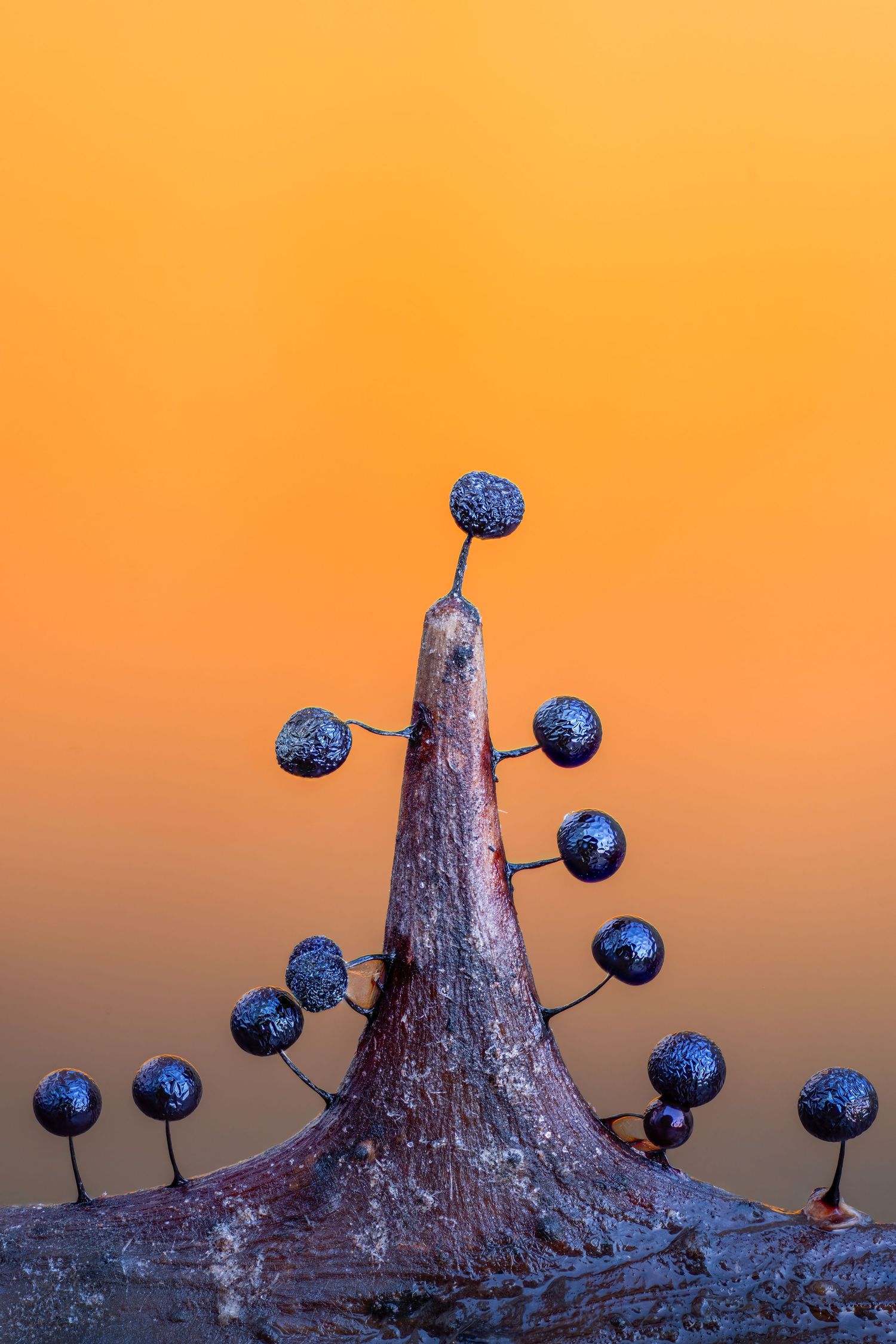
Lamproderma violaceum on a Blackberry Thorn
📷 Camera: Canon EOS R5
🔍 Lens: Canon MP-E 65mm f/2.8 1–5x Macro lens
⚙️ Settings: f/3.2 | 0.5 sec | ISO 250
📸 Technique: 117 Pictures Focus stacked
☀️ Lighting: Natural light
📍 Location: Bognor Regis, West Sussex, UK
A Hidden Treasure Close to Home
The moment I arrived, I knew I had found something special.
The woodchip piles were full of life.Everywhere I looked there were slime molds. Some were species I had photographed before, but many were completely new to me. What I initially expected to be a short walk quickly turned into hours of exploration.
Over the following two months, I returned regularly, and each visit revealed something new. The site became a miniature treasure trove of biodiversity. Species appeared, matured, released their spores, and disappeared, only to be replaced by new arrivals. Every visit felt like opening a surprise gift.
Finding a Species I Had Been Searching For
One of the greatest highlights from this unexpected woodchip site was discovering Lamproderma violaceum. For several months, I had been actively searching for this species throughout woodlands across West Sussex. Every time I visited a promising location, I hoped I might finally come across it. I checked fallen logs, leaf litter, decaying branches, and woodland edges, always keeping an eye out for its distinctive iridescent fruiting bodies. Despite countless hours spent exploring and many miles walked through ancient woodlands, the species remained frustratingly elusive.
As every nature photographer knows, there are some subjects that seem to stay just out of reach. The more you search for them, the more determined you become to find them. Lamproderma violaceum had become one of those species for me.
Then, when I least expected it, everything changed.
I wasn't deep in an ancient woodland. I hadn't travelled hours to a remote nature reserve. In fact, I was only a few minutes from home, standing beside a pile of woodchips that most people would probably walk past without a second glance.
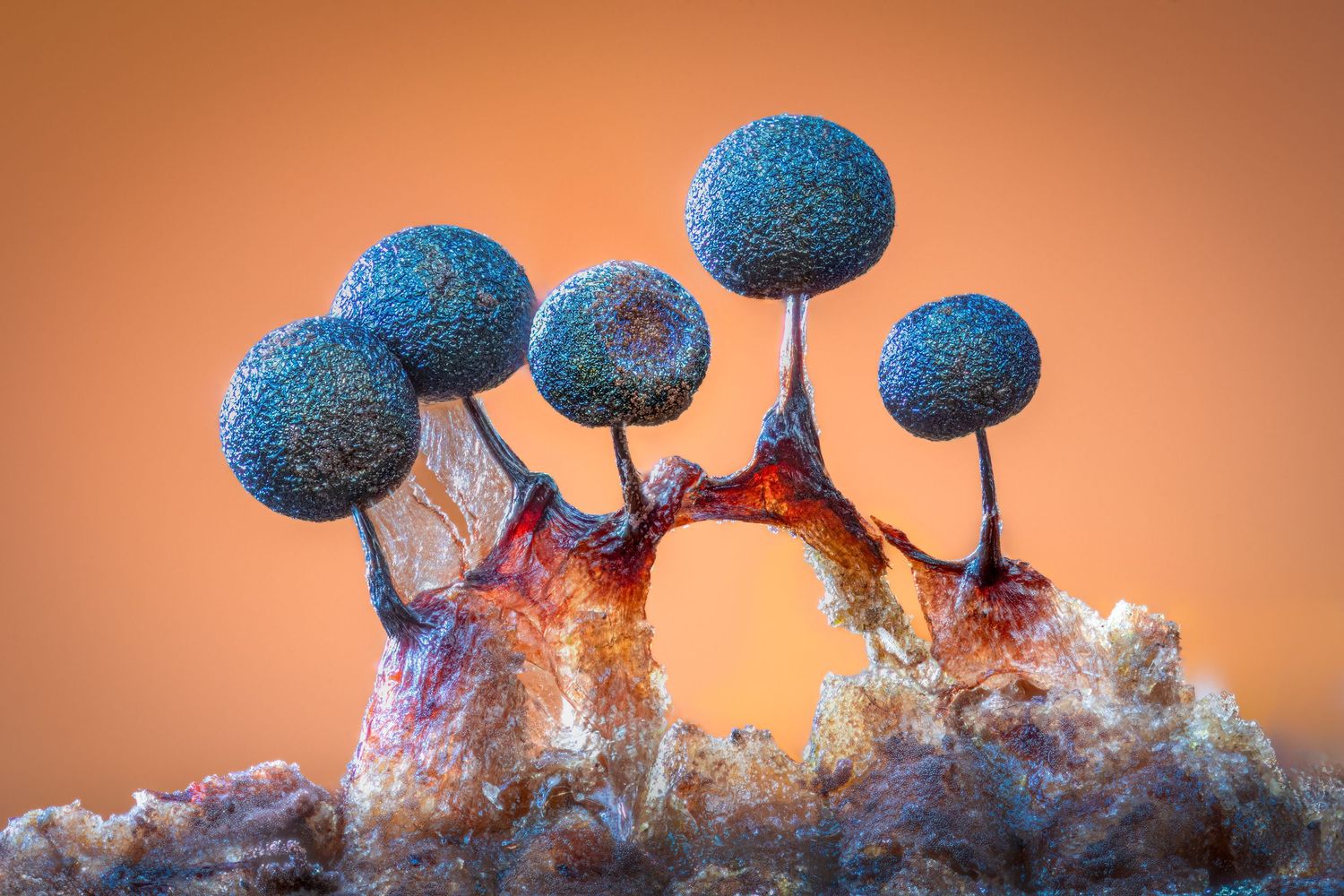
📷 Camera: Canon EOS R5
🔍 Lens: Canon MP-E 65mm f/2.8 1–5x Macro lens
⚙️ Settings: f/4.0 | 0.5 sec | ISO 800
📸 Technique: 79 Pictures Focus stacked
☀️ Lighting: Natural light
As I carefully examined the woodchips, something caught my eye. Tiny metallic spheres glistened amongst the debris. Looking closer, I immediately realised what I was seeing. There it was. Lamproderma violaceum. After months of searching, I had finally found it. The feeling was difficult to describe. There was excitement, relief, and a sense of disbelief all at once. I spent several minutes simply admiring the tiny fruiting bodies before even thinking about setting up my camera. Discovering a species you've searched for over such a long period creates a special connection with the subject. The photograph becomes more than just an image; it becomes the culmination of months of patience, persistence, and hope.
What made the discovery even more remarkable was the location itself. Finding such a beautiful species on a humble pile of woodchips, so close to home, was a powerful reminder that nature doesn't always reveal its treasures in the places we expect. Sometimes the most extraordinary discoveries are waiting in the most ordinary locations.
As I photographed the slime mold, I couldn't help but reflect on how close I had come to missing it altogether. Had my car not broken down that morning, I would have been somewhere completely different. I would never have visited the woodchip pile, and this encounter might never have happened.
Moments like this are one of the reasons I am so passionate about photographing slime molds. They constantly remind me that nature is full of surprises. No matter how much experience you gain, there is always something new waiting to be discovered. The excitement of finding a species for the first time never fades, and each discovery rekindles the same sense of wonder that first drew me into this fascinating world.
For me, Lamproderma violaceum will always be more than just another slime mold species. It represents perseverance, patience, and the unexpected rewards that can come when you remain curious and open to opportunity. Sometimes the photographs we treasure most are not necessarily the rarest or technically perfect images, but those connected to memorable stories and unforgettable moments in the field.
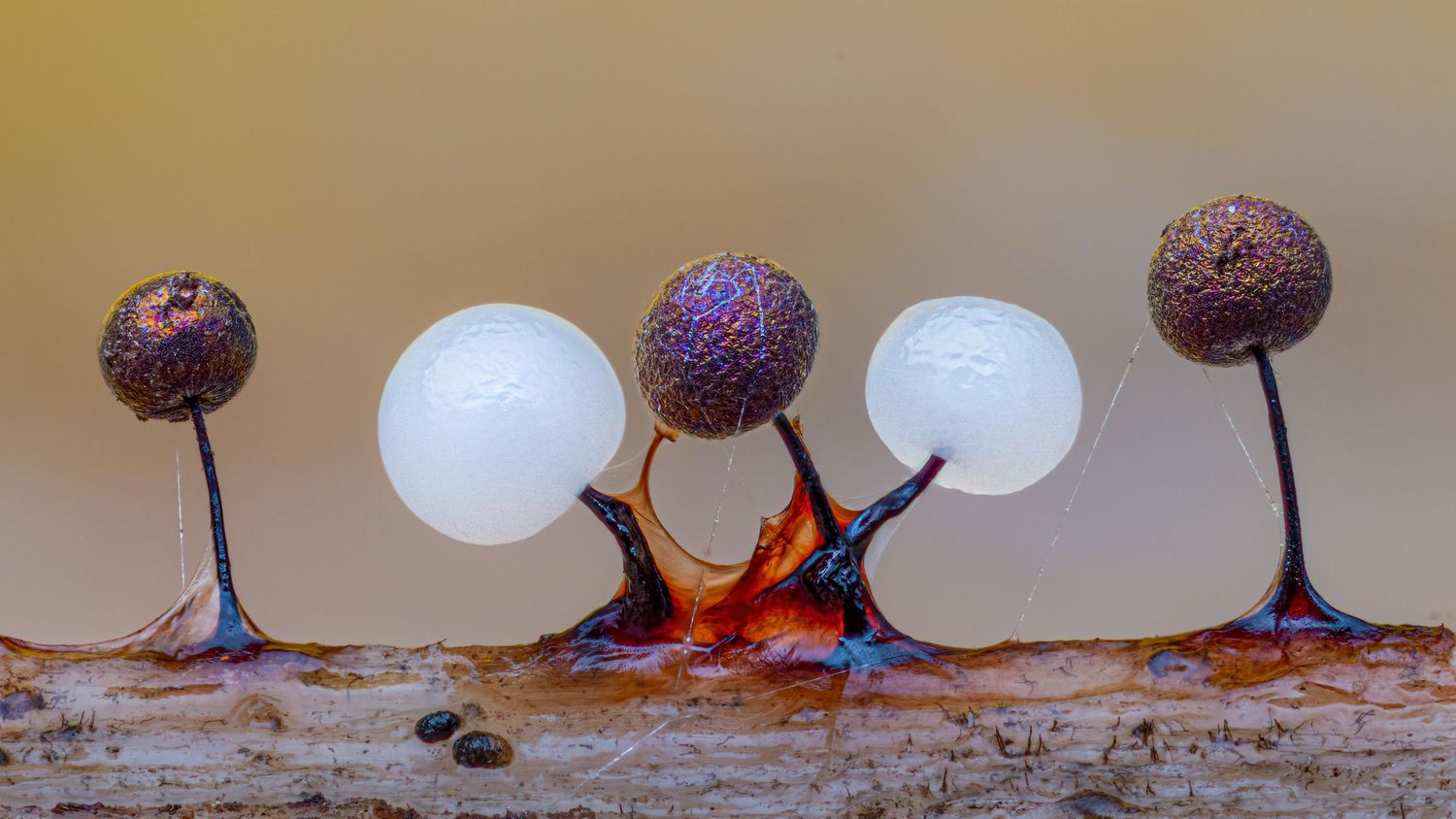
📷 Camera: Canon EOS R5
🔍 Lens: Canon MP-E 65mm f/2.8 1–5x Macro lens
⚙️ Settings: f/3.2 | 1/4 sec | ISO 400
📸 Technique: 105 Pictures Focus stacked
☀️ Lighting: Natural light
Nature's Unexpected Compositions
What made this location even more fascinating was the variety of interactions taking place. I discovered slime molds growing directly on top of other slime molds, creating unusual and rarely photographed compositions. Some species were developing around blackberry thorns, while others appeared to be suspended amongst tiny fragments of wood and bark. Every visit seemed to reveal a new and unexpected scene.
One of the most memorable discoveries was finding Lamproderma scintillans growing directly on top of a Didymium species. The contrast between the two slime molds created a fascinating composition and highlighted just how complex these miniature ecosystems can be. On another occasion, I found Lamproderma violaceum developing on top of a Didymium species, creating yet another unique interaction that I had never encountered before.
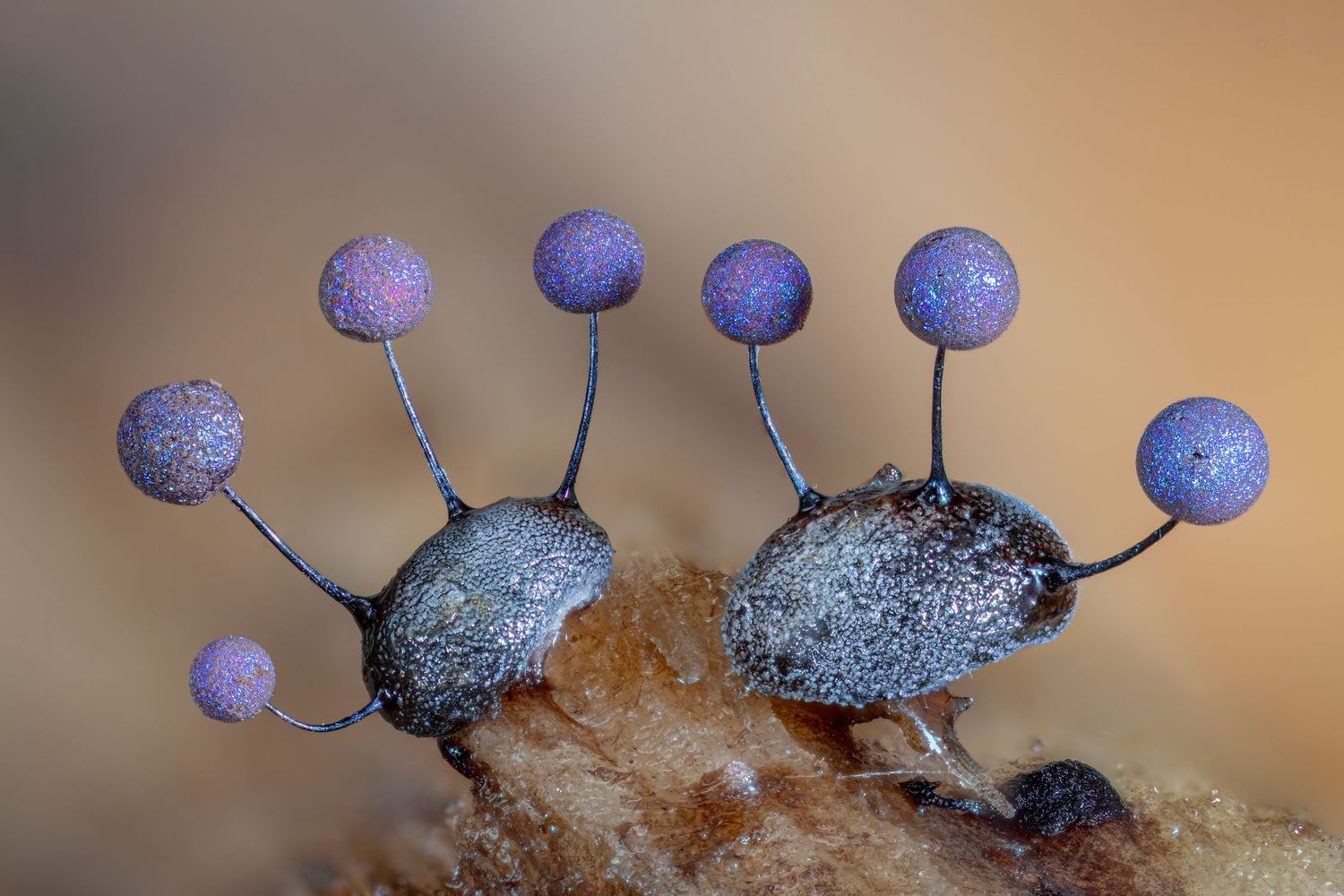
Settings: f/3.2 | 0.5 sec | ISO 320
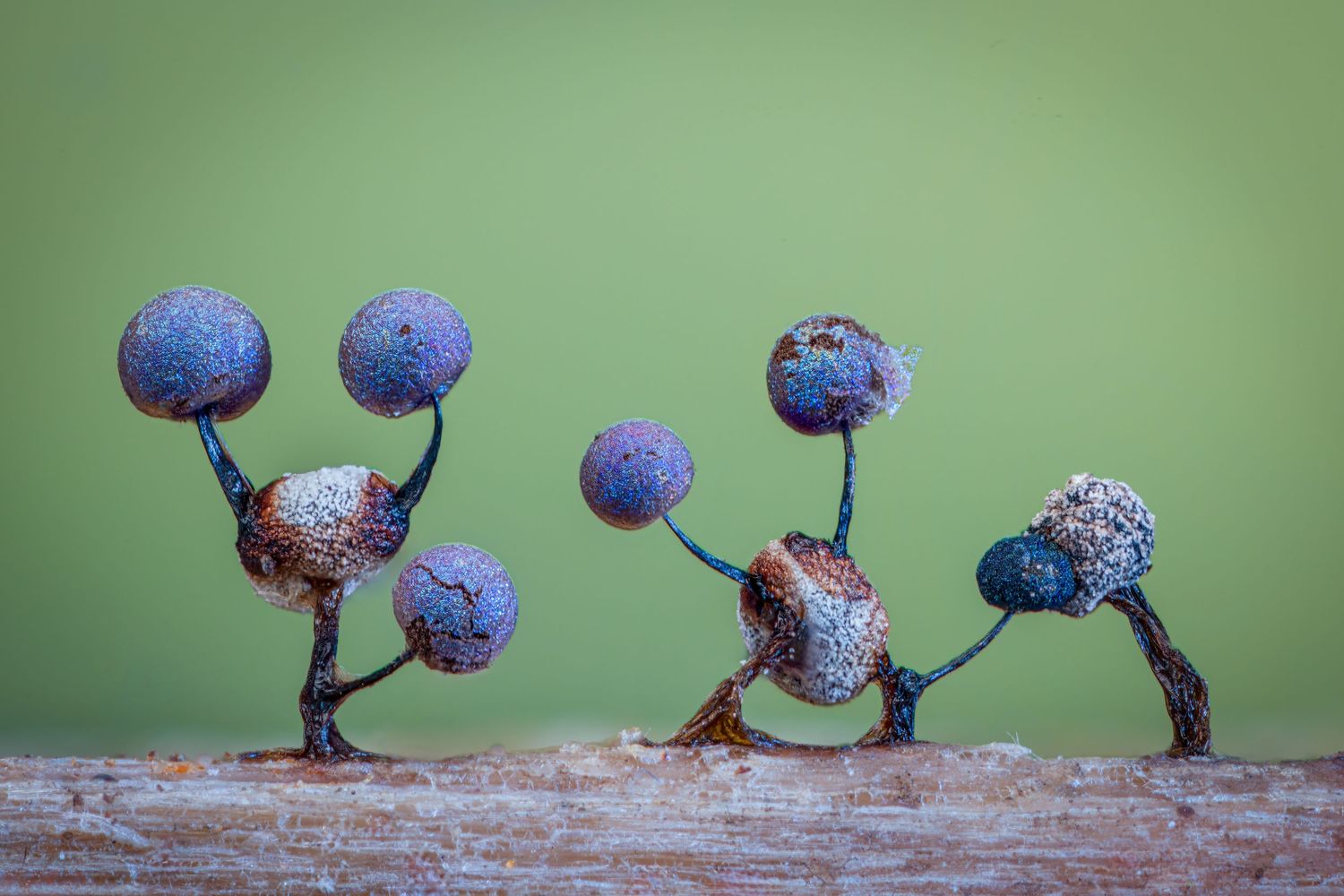
Settings: f/4.0 | 0.5 sec | ISO 400
Perhaps one of the most surprising finds was a beautiful group of Lamproderma scintillans fruiting bodies emerging directly from top of Craterium minutum. Seeing one species developing on another was both visually striking and scientifically intriguing. These are the kinds of discoveries that make every woodland visit exciting, because you never know what unusual behaviour or interaction you might encounter next.
Many of these scenes exist for only a short period before the slime molds mature, release their spores, and disappear. Capturing them requires not only patience and observation but also a little luck. The fleeting nature of these interactions makes every photograph feel even more special.
As photographers, we are always searching for unique images, and this location provided endless opportunities. The more time I spent there, the more I realised how much life existed within what most people would simply walk past without noticing. What appeared to be an ordinary pile of woodchips was actually a thriving micro-world filled with extraordinary beauty, unexpected relationships, and countless photographic possibilities.
Experiences like these are one of the reasons I became so passionate about slime mold photography. They remind me that nature is full of surprises, and that some of the most remarkable discoveries can be found in the smallest and most overlooked places.
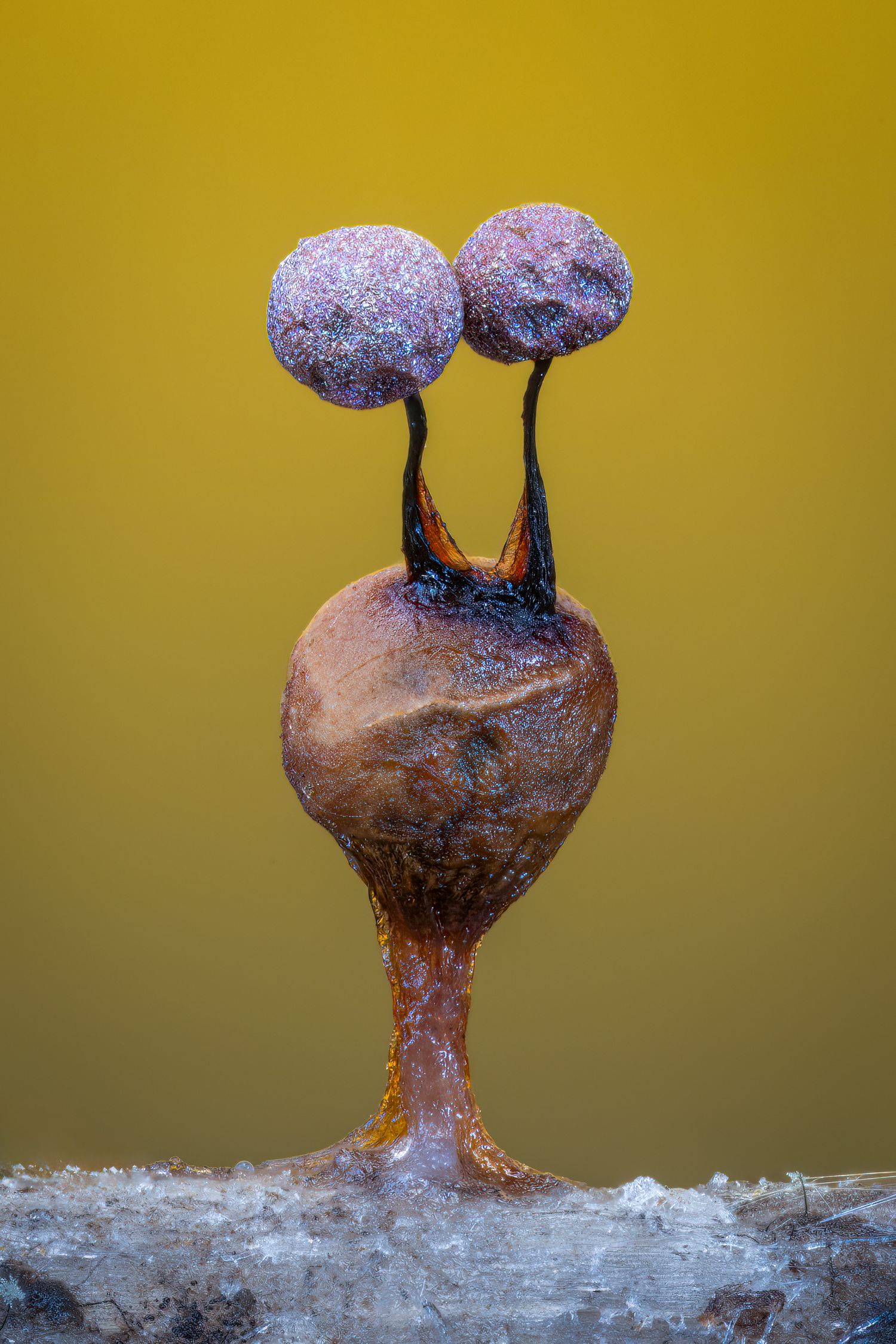
Settings: f/3.2 | 1/4 sec | ISO 400
Craterium minutum on a Blackberry Thorn
Another memorable discovery from the woodchip site was this beautiful group of Craterium minutum growing directly on a blackberry thorn. At first glance, the tiny fruiting bodies looked almost like miniature lanterns or delicate ornaments carefully arranged along the thorn's ridges.
What immediately caught my attention was the way the slime mold had developed around the natural structure of the blackberry thorn. The sharp peaks and curves of the thorn created a dramatic landscape, while the fruiting bodies appeared perfectly positioned along its slopes, giving the scene the appearance of a tiny mountain range inhabited by an alien forest.
Craterium minutum is a small but fascinating species, often measuring only a few millimetres in height. Despite its size, it possesses remarkable detail and elegant form. Through the use of focus stacking, I was able to reveal the intricate textures of both the fruiting bodies and the thorn itself, capturing a level of detail that would otherwise be invisible to the naked eye.
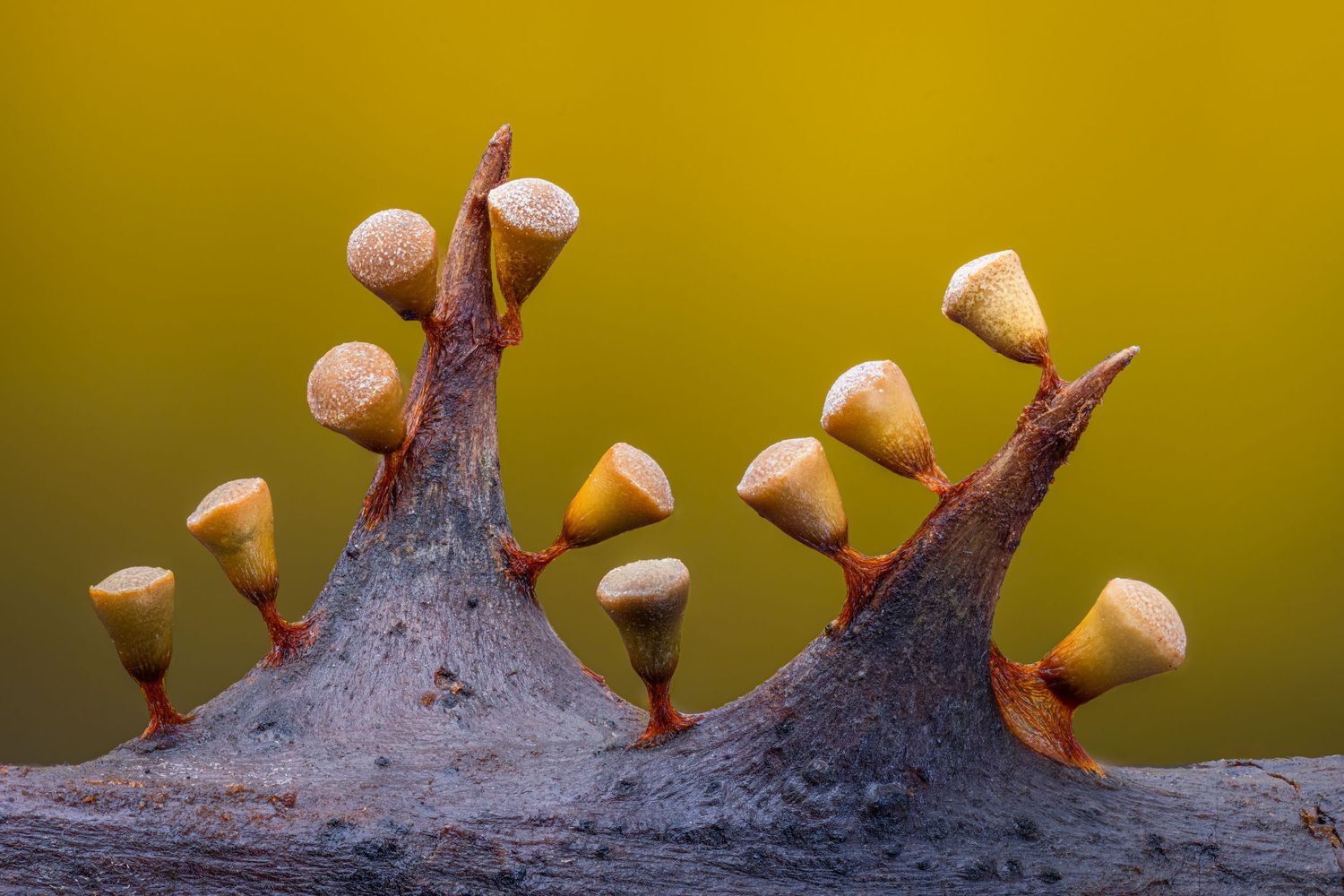
Technical Details
📷 Camera: Canon EOS R5
🔍 Lens: Canon MP-E 65mm f/2.8 1–5x Macro lens
📸 Technique: Focus Stacking
⚙️ Settings: f/3.5 | 1/4 sec | ISO 400
☀️ Lighting: Natural Light
📍 Location: Bognor Regis, West Sussex, UK
A Frosty January Morning
The first week of January brought several nights of sub-zero temperatures and crisp, frosty mornings. A few days earlier, after checking the weather forecast, I had already made a plan. I knew the conditions would be perfect for photographing slime molds covered in frozen dew drops, and I also knew exactly where to go.
Over the previous months, I had discovered a productive woodchip site close to my home that was full of slime molds. With freezing temperatures forecast overnight, I hoped the tiny fruiting bodies would be transformed by frost into something truly special.
Time was limited that morning, as I needed to take my children to school, so travelling to one of my usual woodland locations wasn't possible. Fortunately, the woodchip piles were only a short distance away. As soon as the school run was finished, I headed straight there with my camera.
The conditions were even better than I had hoped.
Discoveries like this are one of the reasons I enjoy slime mold photography so much. Subjects are often found in unexpected places, and the natural compositions created by these tiny organisms can be extraordinary. Rather than needing to arrange anything, nature had already done the work for me. All I had to do was notice it.
Finding Craterium minutum growing on blackberry thorns became a recurring theme at this location, but this particular specimen remains one of my favourites. The combination of colour, structure, and natural symmetry created a scene that felt both artistic and otherworldly.
Images like this remind me that an entire hidden world exists beneath our feet—one filled with beauty, complexity, and endless photographic opportunities for those willing to slow down and look closely.
Technical Details
📷 Camera: Canon EOS R5
🔍 Lens: Canon MP-E 65mm f/2.8 1–5x Macro lens
📸 Technique: 110 pictures focus stacked
⚙️ Settings: f/7.1 | 0.5 sec | ISO 320
☀️ Lighting: Natural Light
📍 Location: Bognor Regis, West Sussex, UK
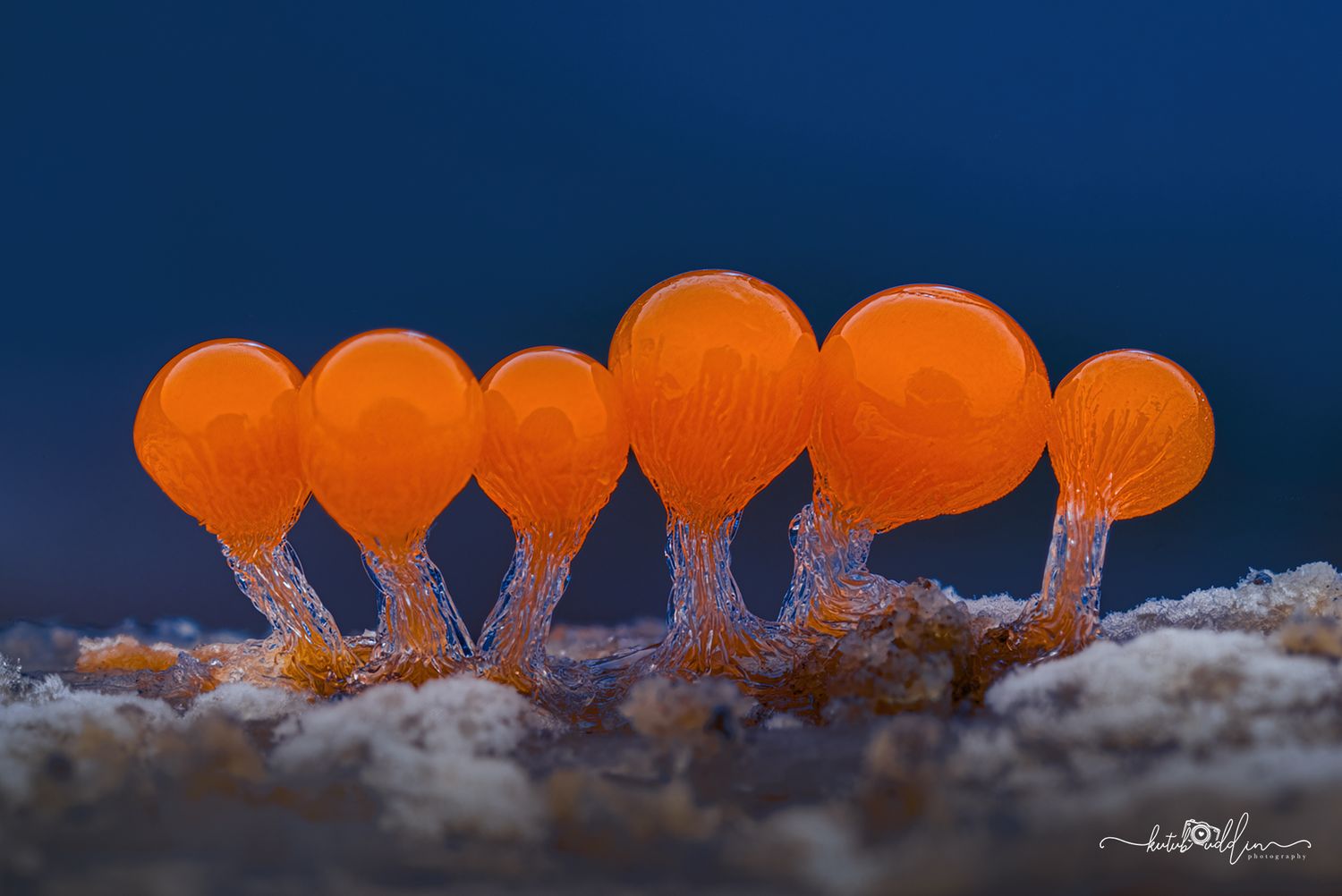
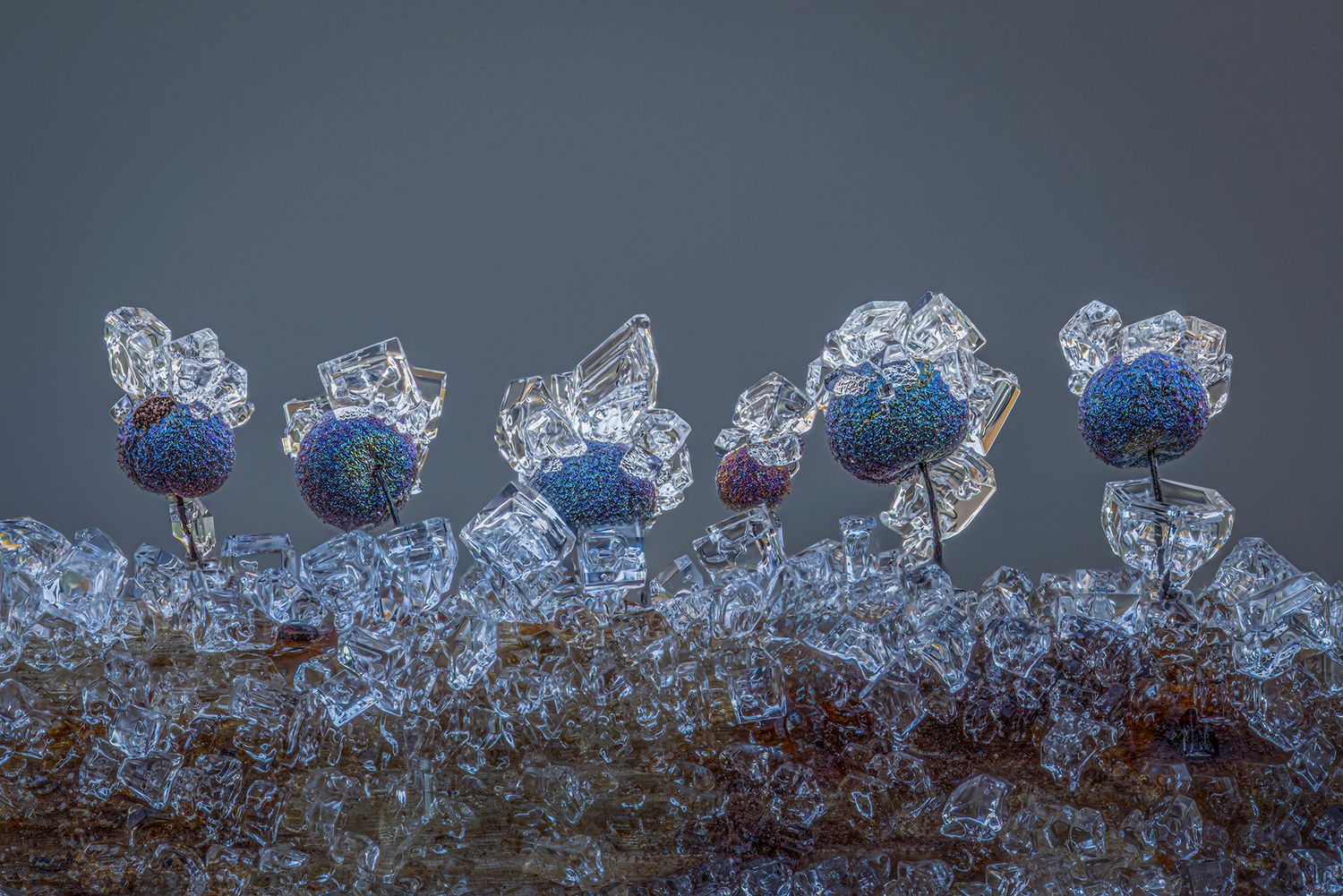
Among the many slime molds present, I found this beautiful group of Lamproderma scintillans covered in delicate frozen dew drops. The tiny iridescent fruiting bodies, already stunning in their own right, had become surrounded by intricate ice crystals that sparkled in the morning light. At such a small scale, the scene looked more like a frozen crystal landscape than a patch of decomposing woodchips.
Photographing frozen slime molds is always challenging. The frost can disappear quickly once temperatures rise, so there is often only a short window to work. Using focus stacking, I carefully captured multiple images to reveal every detail of both the slime mold and the frozen crystals. The final image showcases a hidden world that is rarely seen by the naked eye.
This photograph remains one of my favourite winter slime mold images. It perfectly captures why I love macro photography so much. On an ordinary morning, in an ordinary pile of woodchips close to home, nature had created a scene of extraordinary beauty.
Sometimes the most magical photographic opportunities aren't found in distant locations. They're waiting just around the corner, hidden in places most people would never think to look. ❄️
Lessons From an Unexpected Discovery
Looking back, it's funny to think that none of this would have happened if my car hadn't broken down. Had everything gone according to plan, I would have spent the day exploring Slindon Wood and probably never visited those woodchip piles at all. I would never have discovered Lamproderma violaceum, and I would never have photographed many of the species and behaviours that became some of my favourite images of the year. That experience reinforced several lessons I have learned through photography:
1. Luck Plays a Part
Sometimes nature places something extraordinary in your path when you least expect it. No amount of planning could have predicted that a broken-down car would lead me to one of my best slime mold discoveries.
2. Hard Work Creates Opportunities
Luck alone isn't enough. Countless hours spent searching woodlands, studying habitats, and learning about slime molds meant I recognised the potential of those woodchip piles and knew they were worth exploring.
3. Be Willing to Adapt
Photography often rewards those who can change plans and make the most of unexpected situations. Instead of staying home disappointed, I chose to explore somewhere close by, and that decision changed everything.
4. Great Subjects Can Be Found Anywhere
We often think the best photographs are waiting in remote locations, but some of the most rewarding discoveries can be found much closer to home. In this case, one of my favourite locations was only a ten-minute walk away.
5. Every Setback Can Become an Adventure
What initially felt like a frustrating problem turned into an unforgettable experience. My broken-down car certainly felt like bad news at the time, but it ultimately led me to one of the most productive and exciting slime mold locations I have ever discovered.
6. Never Stop Looking
Nature is full of surprises. The more time you spend observing and exploring, the more likely you are to witness something unusual, beautiful, or completely unexpected.
In the end, this experience reminded me that photography is often a combination of luck, hard work, and opportunity. When those three things come together, amazing things can happen. And all because I decided to take a ten-minute walk from home.

Thank You for Reading
Thank you for taking the time to read about my journey into the fascinating world of slime molds.
What began as a chance discovery during a fungi workshop in October 2024 quickly grew into a passion that has taken me on countless adventures, introduced me to an incredible community of enthusiasts, and revealed a hidden world I never knew existed. From searching ancient woodlands to discovering rare species on a humble pile of woodchips close to home, every experience has taught me something new about nature, photography, and the importance of curiosity.
I hope these stories and photographs have inspired you to look a little closer at the natural world around you. Sometimes the most extraordinary subjects are not found in distant locations or famous landscapes, but in the small and overlooked corners that most people walk past every day. All it takes is a little patience, observation, and a willingness to explore.
Photography has taught me that nature is full of surprises. Some of my favourite discoveries have happened when things didn't go according to plan, proving that unexpected moments often lead to the most rewarding experiences.
This is only the beginning of my slime mold journey. There are still hundreds of species I hope to find, photograph, and learn more about. Every woodland walk holds the possibility of a new discovery, and every season brings fresh opportunities.
Thank you again for joining me on this journey.
Until next time, keep exploring, keep looking closely, and never stop being curious.
Another day will come with another story, another adventure, and hopefully another rare and exciting find waiting to be discovered.
Happy photographing!
Kutub Uddin
Nature, Wildlife & Slime Mold Photographer 📷🍄✨